
What if the biggest risk to your winter peace of mind isn't the heavy Manitoba snow, but a simple misunderstanding of who is actually responsible for clearing it? You likely feel the physical strain of every blizzard and worry about "slip and fall" lawsuits if your property isn't perfect. It's confusing when some sources claim you have a legal deadline to clear paths while the City's official policy suggests they handle the plowing. This Winnipeg sidewalk snow removal bylaw explained guide clarifies these contradictions so you can stop guessing and start planning.
We promise to give you a clear map of your legal obligations for the 2026 season, including the details of the new distance laws for snow removal vehicles that took effect on January 1, 2026. You'll learn why staying 30 to 100 meters back from a plow can save you a $298 fine and two demerit points. This guide covers the City’s priority clearing system and the noise restrictions that keep your neighborhood quiet after 9 p.m., giving you the expert knowledge needed for a hassle-free winter.
Key Takeaways
- Get the Winnipeg sidewalk snow removal bylaw explained so you can distinguish between the City's plowing responsibilities and your own legal obligations.
- Learn how the City’s P1, P2, and P3 priority system determines exactly when your street's sidewalks will be cleared after a major storm.
- Identify the specific geographic zones where the 48-hour clearing rule is strictly enforced for business and property owners.
- Understand how 311 reports and bylaw inspections work to protect yourself from unexpected fines and liability.
- Discover how a professional "set it and forget it" maintenance plan provides year-round peace of mind and total winter compliance.
What is the Winnipeg Sidewalk Snow Removal Bylaw?
Many residents search for a specific "snow bylaw," but the rules are actually found in the City's Snow Clearing & Ice Control Policy. This document isn't just a set of suggestions. It's a formal framework managed by the City of Winnipeg Public Works Department. Their primary goal is to maintain safety for motorists, cyclists, and pedestrians during our famously long winters. Having the Winnipeg sidewalk snow removal bylaw explained helps you understand that while the City takes the lead on many streets, the responsibility for a safe community is shared with every homeowner.
The policy receives regular updates to keep pace with how Winnipeggers move. As of the 2026 winter season, the City has introduced new mandates for active transportation pathways. These updates ensure that bike lanes and pedestrian corridors receive faster attention than in previous years. This change reflects a commitment to year-round mobility, ensuring that those who don't rely on cars can still navigate the city safely after a major blizzard.
The Legal Framework: Policy vs. Bylaw
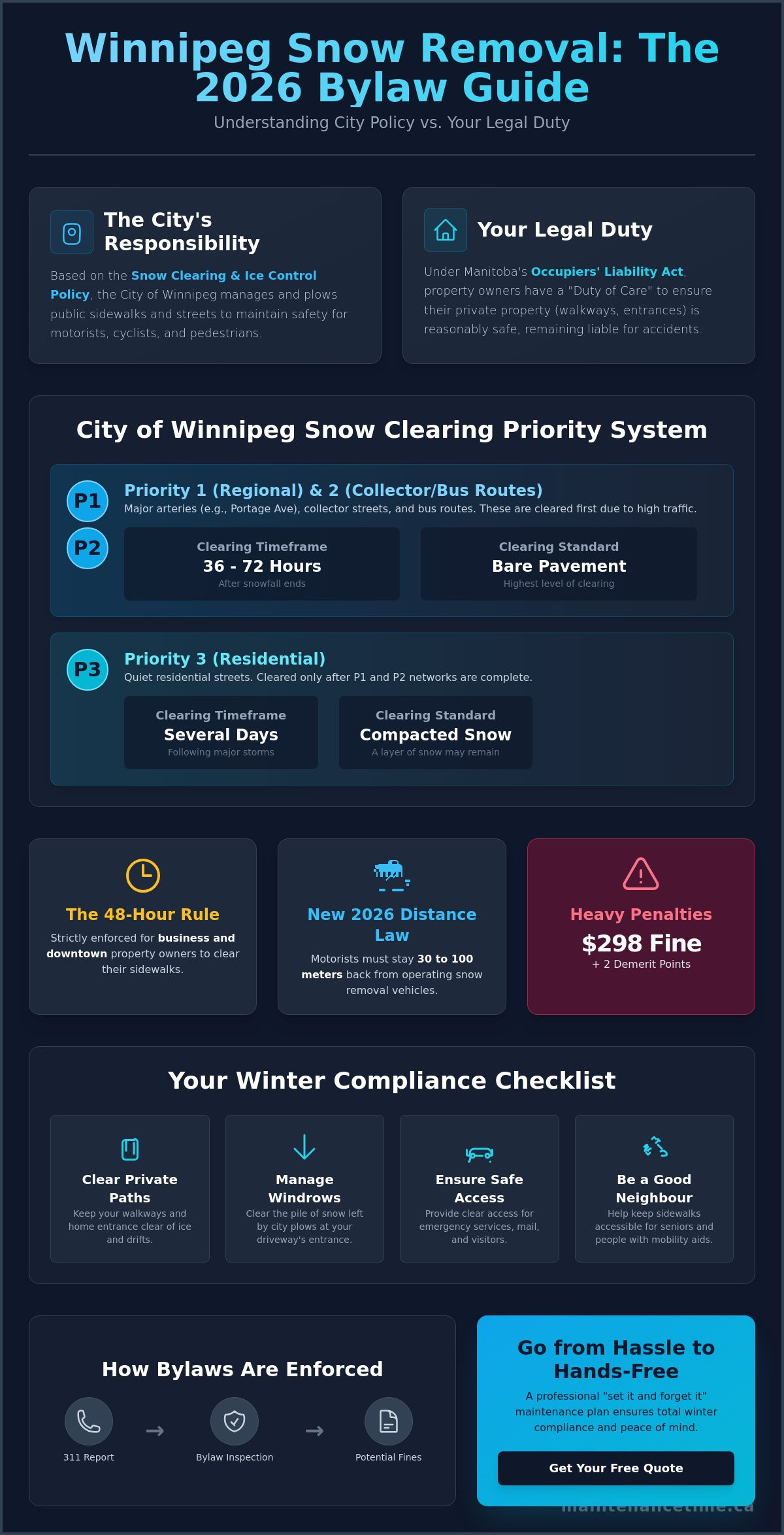
The Neighbourhood Liveability Bylaw works in tandem with the City’s snow policy to regulate property maintenance. Under Manitoba’s Occupiers' Liability Act, property owners have a "Duty of Care" to ensure their premises are reasonably safe for anyone who enters. This legal obligation means your responsibility doesn't vanish just because the City plows the main sidewalk. If your private walkway or the approach to your home is hazardous, you remain liable for any accidents. While the City handles the heavy lifting on most residential sidewalks, you must ensure that your specific property entrance remains clear of ice and drifts to protect visitors and passersby.
Why Winnipeg Homeowners Must Stay Informed
Winnipeg winters are relentless, and staying informed is the best way to avoid stress. Heavy snow can quickly block access for vital services. Emergency responders, such as paramedics and firefighters, need clear paths to reach your door without delay. Similarly, Canada Post carriers rely on unobstructed walkways to deliver mail safely. When you follow general snow removal practices, you're doing more than just avoiding a complaint; you're participating in a "good neighbour" standard that keeps the entire block accessible for seniors and people with mobility aids.
Understanding the Winnipeg sidewalk snow removal bylaw explained in this guide gives you the confidence to manage your property correctly. It's about more than just moving snow. It's about knowing when the City will show up and when you need to grab the shovel to keep your corner of the neighborhood safe and compliant.
Priority Levels: Who is Responsible for Your Sidewalk?
Winnipeg doesn't clear every sidewalk at once. It follows a strict hierarchy based on traffic volume and transit needs. The City uses a three-tier priority system to decide which paths get the plow first. Understanding these tiers is the best way to get the Winnipeg sidewalk snow removal bylaw explained in a way that helps you plan your winter. You can find your specific street's priority by using the City's "Know Your Zone" map or by calling 311. This knowledge prevents the frustration of waiting for a plow that might not arrive for several days.
Priority 1 (Regional) and Priority 2 (Bus Routes)
Priority 1 (P1) streets are the city's main arteries. Think of major thoroughfares like Portage Avenue, Main Street, or Henderson Highway. These sidewalks are cleared first because they see the highest foot traffic and lead to major transit hubs. Priority 2 (P2) routes include bus routes and collector streets that connect neighborhoods to the P1 network. The City of Winnipeg aims to have P1 and P2 sidewalks plowed within 36 to 72 hours after a snowfall ends. Their goal is to reach a "bare pavement" standard on these high-traffic areas to ensure commuters and pedestrians can move safely without navigating deep drifts.
Priority 3 (Residential) Sidewalk Rules
Most Winnipeggers live on Priority 3 (P3) streets. These are the quiet residential blocks where the City’s presence is less frequent. P3 sidewalks are only cleared after the P1 and P2 networks are fully addressed. This often means a delay of several days following a major Manitoba blizzard. While the City does eventually plow these areas, they typically aim for a "compacted snow surface" rather than bare concrete. This means you should still expect a layer of snow to remain, which can turn into ice if the temperature fluctuates.
This is where homeowners often feel the most strain. If a City plow clears the street but leaves a "windrow" (a heavy pile of snow) across your sidewalk or driveway, the City generally expects you to handle the final cleanup. Back lanes follow a different schedule entirely. They are plowed to a compacted surface to allow for garbage and recycling collection, but the City does not clear the private approaches or the small paths connecting your yard to the lane. If you find yourself constantly struggling with heavy windrows or the City's slow P3 schedule, you might consider a professional snow clearing service to ensure your property stays accessible and safe regardless of the municipal timeline.
Keeping your property compliant means staying ahead of these priority timelines. While the City takes responsibility for the initial plow on most residential sidewalks, the "Duty of Care" mentioned earlier means you must ensure the path remains walkable. If a City plow is delayed, the physical strain of clearing a 40-centimeter accumulation falls on the homeowner. Being aware of your street's priority level allows you to decide whether to wait for the City or take action yourself to prevent ice buildup and potential "slip and fall" hazards.
The 48-Hour Rule: Commercial and Downtown Requirements
While residential homeowners often wait for City plows, business owners and downtown property managers operate under a much tighter clock. Having the Winnipeg sidewalk snow removal bylaw explained for these high-traffic areas is essential for avoiding steep bills and legal headaches. In specific zones, the City mandates that sidewalks be cleared within 48 hours after the snow stops falling. This rule ensures that our busiest streets remain safe for the thousands of Winnipeggers who walk to work or shop every day.
Compliance isn't just about pushing snow to the side. You're required to clear the full width of the sidewalk down to the pavement. This standard allows for two-way pedestrian traffic and ensures that individuals using mobility aids can pass without obstruction. Because these areas see constant foot traffic, the City prioritizes enforcement here to prevent the snow from being packed into dangerous, permanent ice ridges. If you don't have the equipment to reach bare pavement within two days, you risk both a fine and a bill for City-contracted clearing.
Downtown Winnipeg Specific Obligations
The 48-hour requirement is strictly enforced in the Downtown Winnipeg area, including the Exchange District and the Broadway corridor. If a property owner fails to clear their frontage, the City doesn't just issue a warning. They have the right to hire a contractor to do the work and add the cost directly to your property tax bill. While the Downtown Winnipeg BIZ provides valuable assistance with general maintenance and beautification, the legal duty to keep the sidewalk clear rests solely on the property owner. This means you can't rely on the BIZ crews to handle your specific storefront responsibilities after a major storm.
Commercial Property Standards
This rule also applies to strip malls and standalone businesses located within residential neighborhoods. Business owners must be diligent about more than just the depth of the snow. Liability risks are high in Manitoba, and ignoring an icy patch can lead to a "slip and fall" lawsuit that far exceeds the cost of professional maintenance. Your clearing routine should always include the application of sand or salt to provide traction. This extra step is a key part of the "clearing" process defined by the City. It demonstrates that you've taken reasonable steps to protect the public, which is a vital defense in any legal dispute regarding property safety. Keeping your business accessible isn't just about following the law; it's about making sure your customers feel safe from the moment they step onto your property.
Fines, Liability, and Enforcement in Winnipeg
Enforcement of winter property standards in Winnipeg is more active than many residents realize. While the City takes the lead on plowing, the Neighbourhood Liveability Bylaw gives officers the power to ensure properties don't become a public hazard. Having the Winnipeg sidewalk snow removal bylaw explained means understanding that compliance is monitored through a complaint-driven system. If a sidewalk is deemed unsafe or a property owner in a commercial zone misses the 48-hour window, the City can take direct action to resolve the issue at the owner's expense.
A common misconception is that City plowing absolves you of all liability. Even if a City plow has cleared your residential P3 sidewalk, you still have a legal duty to ensure the area is safe for visitors. If a plow leaves a frozen windrow or creates an icy patch at your property’s edge, you're expected to address it. For those traveling during the winter, remember that as of January 1, 2026, new traffic laws carry heavy penalties. Failing to maintain a 30-meter distance from snow removal vehicles on most city roads results in a preset fine of $298 and two demerit points. Staying informed helps you avoid these costly surprises both on the road and at your front door.
The 311 Reporting System
The 311 system is the primary tool for reporting uncleared or hazardous sidewalks. When a report is filed, a bylaw officer typically visits the site to conduct an inspection. In most residential cases, the officer provides a warning notice first, giving the homeowner a specific timeframe to clear the hazard. However, if the issue persists or if you're in a high-priority commercial zone, the City may skip the warning and hire a private contractor to clear the snow. The cost of this service is then added to your property tax bill, often at a rate much higher than private maintenance fees. If you receive a notice, the best move is to act immediately to avoid these additional administrative costs.
Liability and the Occupiers’ Liability Act
Manitoba’s Occupiers’ Liability Act is the legal backbone for "slip and fall" claims in Winnipeg. This law requires property owners to take "reasonable care" to ensure that people entering their property are safe from foreseeable harm. In a legal context, reasonable care means you must take the same steps a sensible person would to prevent injury, such as applying sand to ice or clearing heavy drifts promptly. Documenting your maintenance schedule is your best defense against a claim. If you can show that you cleared the walk every morning at 8 a.m., it's much harder for a claimant to prove negligence. To ensure your property always meets this legal standard without the physical struggle, you can sign up for professional snow removal and let the experts handle the liability for you.
Hassle-Free Winter Maintenance with Maintenance Time
Managing a property in Manitoba is a full-time job during the winter months. Now that you've had the Winnipeg sidewalk snow removal bylaw explained, you know that missing a single snowfall event can lead to 311 reports or expensive city-contracted clearing bills. Maintenance Time eliminates this risk with our dedicated residential and commercial snow removal services. We take pride in being a reliable partner for homeowners who want to reclaim their time and avoid the physical toll of heavy lifting. Our "set it and forget it" contracts mean we monitor the weather and show up automatically. You never have to worry about compliance or neighborhood complaints when our expert teams are on the job.
Our commitment to quality means we don't just push snow around. We clear right down to the pavement to meet the highest bylaw standards and prevent ice from bonding to your walkways. This level of consistency is what separates a professional service from a casual arrangement. By hiring Maintenance Time, you're ensuring that your property remains a safe environment for mail carriers, emergency responders, and guests. We treat every property with the same pride and attention to detail that we'd give our own homes, providing you with total peace of mind all winter long.
Professional Snow Removal vs. DIY
Busy families in Winnipeg often find that a single blizzard can derail their entire week. Professional snow removal isn't just a luxury; it's a practical way to ensure your property meets the 2026 safety standards without risking a back injury. Our teams use professional-grade equipment that clears paths faster and more effectively than a standard hand shovel. This prevents the "packed snow" effect that often leads to dangerous ice ridges. For a complete look at how to protect your home this season, check out our Essential Winnipeg Property Maintenance Checklist for 2026. We help you stay organized so that winter maintenance is never a source of stress.
Customized Plans for Every Priority Zone
We understand that every property has different needs based on its priority zone. If you're in a P3 residential area, we ensure you aren't left waiting days for the City plow to arrive. We handle the heavy windrows left by municipal equipment so your sidewalk stays accessible. For downtown business owners facing the strict 48-hour rule, our rapid response teams guarantee that your storefront is clear and salted before the enforcement window closes. We provide the expert care your property deserves, regardless of whether you're on a major bus route or a quiet side street. Get a hassle-free snow removal quote from Maintenance Time today!
Stay Safe and Compliant All Winter Long
Winning the battle against Manitoba's winter starts with knowing the rules. This Winnipeg sidewalk snow removal bylaw explained guide highlighted how the city’s priority system affects your specific street and why downtown businesses must act within the strict 48-hour window. Whether you’re avoiding a $298 fine for distance violations or protecting yourself from liability under the Occupiers’ Liability Act, staying proactive is the only way to ensure a hassle-free season. You don't have to face the drifts alone or worry about 311 complaints when the snow starts to pile up.
Maintenance Time has been serving the Winnipeg community since 2018 with dedicated, expert care. Our team provides reliable 24/7 weather monitoring and is fully insured to give you complete peace of mind. We take the physical strain out of every blizzard so you can focus on what matters most. Let Maintenance Time handle the snow so you stay bylaw-compliant all winter long! Our professional service ensures your property remains safe and accessible from the first frost to the final thaw. Enjoy the season knowing your property is in expert hands.
Frequently Asked Questions
Do I have to shovel the sidewalk in front of my house in Winnipeg?
The City of Winnipeg is responsible for plowing most residential sidewalks on a priority basis. However, you are still responsible for clearing your own driveway, the property approach, and any private walkways leading to your door. If your property is located within a designated commercial or downtown zone, you are legally required to clear the public sidewalk yourself.
How long do I have to clear snow from my sidewalk before I get a fine?
Commercial and downtown property owners must clear their sidewalks within 48 hours after a snowfall ends. Residential homeowners don't have a specific hourly deadline for city sidewalks, but they must address hazards if they receive a notice from a bylaw officer. Getting the Winnipeg sidewalk snow removal bylaw explained by an expert helps you understand these different timelines to avoid unexpected citations.
What happens if the City plow leaves a pile of snow on my sidewalk?
This pile is known as a windrow, and the City’s policy states that homeowners are responsible for clearing it. While the City handles the main plowing of the sidewalk path, they do not clear the heavy ridges left behind at the end of driveways or across walkways. Clearing these windrows promptly ensures your property remains accessible for mail carriers and emergency services.
Is it illegal to shovel snow from my driveway onto the street in Winnipeg?
Yes, it is illegal to move snow from your private property onto any public street or sidewalk. This practice violates the Streets By-law because it creates dangerous obstacles for motorists and can block essential drainage systems. Always pile snow on your own yard or contact a professional service to haul it away if you run out of space.
Who is responsible for clearing snow from bus stops in residential areas?
The City of Winnipeg Public Works Department handles the clearing of all bus stops. Because these are high-traffic areas, they are cleared as part of the Priority 1 and Priority 2 schedules. The City aims to have these areas cleared within 36 to 72 hours after a storm ends to ensure transit remains accessible for all residents.
Can I be sued if someone slips on the sidewalk in front of my house?
You can be held liable under Manitoba’s Occupiers' Liability Act if someone is injured due to your negligence. You have a legal "Duty of Care" to ensure your property, including the approach to the public sidewalk, is reasonably safe. This is why having the Winnipeg sidewalk snow removal bylaw explained is so important; it helps you manage your liability by maintaining a safe environment.
Does the City of Winnipeg provide sand for residential sidewalks?
Yes, the City provides free sand for residents at several designated locations throughout Winnipeg. These sand boxes are typically found at local community centers and libraries during the winter months. Using this sand on icy patches is a practical way to meet your safety obligations and prevent "slip and fall" accidents on your property.
How do I report an uncleared sidewalk that is a safety hazard?
You can report hazardous or uncleared sidewalks by contacting 311 by phone or email. The City also provides an online reporting tool on their official website for bylaw complaints. Once a report is filed, a bylaw officer will visit the location to determine if the property owner is in violation of the Neighbourhood Liveability Bylaw.


