

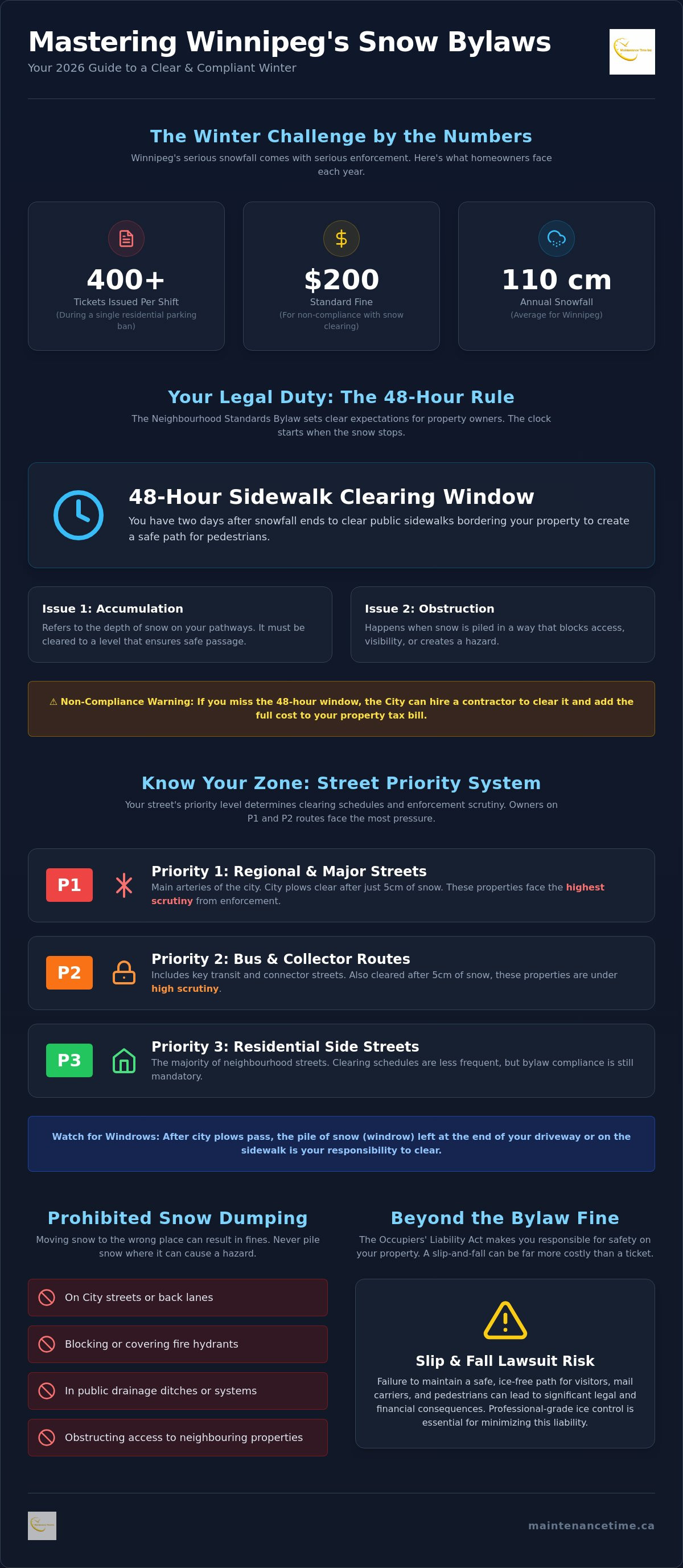
Did you know that during a single residential parking ban, the City of Winnipeg has issued over 400 tickets per enforcement shift? It's a staggering figure that highlights just how serious municipal enforcement has become. Most homeowners find the maze of P1, P2, and P3 street rules more exhausting than the actual shovelling. It's stressful to worry about a $200 fine or a potential slip and fall lawsuit while you're already battling 110 centimetres of annual snowfall. We understand that you want a clear, safe property without the constant anxiety of a surprise ticket in the mail.
This guide will help you master Winnipeg snow clearing bylaw compliance so you can keep your property accessible and your wallet full. You'll learn exactly what the city expects from you this season. We'll break down the 2026 regulations, from noise restrictions on snowblowers to the latest parking ban penalties, giving you the peace of mind you deserve all winter long.
Key Takeaways
- Learn the specific legal requirements of the Neighbourhood Standards Bylaw to protect your property from municipal enforcement and fines.
- Understand the critical 48-hour window for sidewalk maintenance and how professional services ensure consistent Winnipeg snow clearing bylaw compliance.
- Identify prohibited snow disposal zones to avoid penalties for blocking city streets, fire hydrants, or public drainage systems.
- Discover how the Occupiers' Liability Act affects your property and why professional-grade ice control is essential for preventing lawsuits.
- Explore the benefits of automatic clearing thresholds that provide a "set-it-and-forget-it" solution for your winter maintenance needs.
Understanding Winnipeg’s Snow and Ice Control Bylaws
Winnipeg winters are legendary, and the city's enforcement of snow rules is just as serious. Many residents confuse the City’s internal Snow and Ice Control Policy with the Neighbourhood Standards Bylaw No. 11/2010. The policy is essentially the city’s internal manual. It tells municipal crews when to plow and which streets come first. The Neighbourhood Standards Bylaw is different. It's the law that applies directly to you as a property owner. This bylaw sets the legal requirements for your walkways and driveways. Achieving Winnipeg snow clearing bylaw compliance requires understanding how these two frameworks interact.
The city prioritizes enforcement in high-traffic pedestrian zones. If your property is near a hospital, school, or major transit hub, you're under a microscope. Safety is the primary driver here. When the Mayor declares a "Snow Emergency," standard rules often shift. These declarations allow the city to implement temporary parking bans or change clearing priorities. Staying informed during these events is the only way to avoid surprise tickets. We've seen enforcement increase steadily since 2018, so being proactive is your best defense.
The Neighbourhood Standards Bylaw Explained
This law requires you to maintain a "safe" path of travel on your property. The city looks for two main issues: accumulation and obstruction. Accumulation refers to the depth of the snow on your path. Obstruction happens when snow is piled in a way that blocks access or visibility. Usually, you have a 48-hour window to clear your sidewalks after the snow stops falling. Using effective general snow removal methods ensures you meet this deadline before the ice bonds to the concrete. If you miss this window, the city can hire a contractor to clear it and add the cost to your property taxes. It's a bill no homeowner wants to receive.
Priority Street Systems (P1, P2, P3)
Your street's priority level significantly impacts your maintenance routine. Winnipeg classifies streets into three tiers. Priority 1 (P1) routes are regional streets and major arterials. Priority 2 (P2) routes include bus routes and collector streets. Priority 3 (P3) covers residential side streets. Owners on P1 and P2 routes face the most scrutiny because these areas see the highest foot traffic. Maintaining Winnipeg snow clearing bylaw compliance is often harder for these owners. City plows clear P1 and P2 roads after just 5cm of snow, which often means more "windrow" snow pushed onto your driveway approach. You can easily find your street's priority on the City of Winnipeg's Open Data map. Knowing your tier helps you predict when city plows will arrive and when you need to be ready to clear your property.
Sidewalk Clearing Rules: 48-Hour Compliance and Beyond
Winnipeg's winter doesn't wait for your schedule. Once the last snowflake hits the ground, the clock starts ticking on your legal obligations. For residential property owners, the 48-hour rule is the gold standard for safety. You have two days to ensure your walkways are clear and safe for pedestrians. Commercial properties face even tighter scrutiny. For businesses, "bare pavement" isn't just a goal; it's often the expected standard to ensure total accessibility and reduce liability. The city expects high-traffic areas to be cleared to the surface to prevent the freeze-thaw cycle from creating dangerous ruts. If you manage a storefront, your compliance window might feel even shorter due to constant foot traffic packing down the snow.
While maintaining a safe physical storefront is crucial for commercial success, ensuring your organization is visible and engaging online is equally important; for professional digital growth, Web Words Intl specializes in helping SMEs and non-profits succeed.
It's vital to distinguish between your private walkway and the public sidewalk. While the city handles many public paths, your responsibility under Winnipeg snow clearing bylaw compliance often includes keeping those paths clear of ice and windrows. When city plows pass by, they often leave a wall of snow, known as a windrow, across your sidewalk or driveway. Legally, the city clears the street, but you're responsible for the portion blocking your pedestrian access. If you find the physical demand too high, scheduling professional snow removal is the most reliable way to stay ahead of the city's enforcement teams.
Maintaining Winnipeg snow clearing bylaw compliance isn't just about avoiding fines. It's about community safety and ensuring everyone can move through our city safely. Windrows are a common pain point, and while it's frustrating to shovel twice, the bylaw doesn't grant exemptions for plow-related blockages. Keeping your property accessible means tackling these obstacles promptly to avoid complaints or municipal intervention.
Step-by-Step Compliance Timeline
Start your timer when the snowfall officially ends. Don't wait for the sun to come out. Your first pass should remove the bulk of the accumulation. Follow this with a secondary treatment of sand or ice melt to prevent bonding. We recommend taking a quick photo of your cleared path. This documentation serves as proof of your diligence if a neighbour files a complaint or a slip-and-fall claim occurs. It's a simple step that provides massive protection.
Exemptions and Municipal Sidewalk Clearing
The City of Winnipeg does clear many sidewalks, but they follow a strict hierarchy. Priority 1 and 2 sidewalks are cleared after 5 cm of snow. Priority 3 residential sidewalks aren't touched until accumulation hits 8 cm. If a city-owned sidewalk remains blocked after these thresholds, you can report it via 311. However, partial clearing, leaving a thin layer of packed snow, rarely meets the "safe" standard required by local bylaws. You must ensure the path is truly traversable for all residents, including those with limited mobility.
Prohibited Snow Dumping: Where You Can (and Can't) Move Snow
Many homeowners reach a point in mid-February where they simply don't know where to put the next shovel full of snow. It's tempting to push that extra accumulation across the road or onto the city boulevard. However, Winnipeg snow clearing bylaw compliance strictly prohibits moving snow from private property onto public streets or lanes. This rule exists for more than just aesthetics. When you move snow into the street, you create uneven surfaces and narrow the drivable path for your neighbours. The city takes this seriously, and inspectors often patrol residential areas after major storms to identify violators.
Pushing snow onto a neighbour's property is another common source of local conflict. Without explicit consent, dumping your snow across the property line is considered a nuisance. You're legally required to keep all snow cleared from your driveway and walkways within the boundaries of your own lot. On small urban lots in the West End or River Heights, this requires careful planning. You might need to pile snow higher in your yard or consider professional hauling if the accumulation exceeds your property's capacity. It's about being a good neighbour while staying on the right side of the law.
Never block fire hydrants, mailboxes, or drainage systems. Emergency services need instant, unobstructed access to hydrants at all times. If a fire occurs and the hydrant is buried under your snow pile, every second lost is a massive risk. Similarly, Canada Post requires clear access to mailboxes to ensure safe delivery. Drainage systems are equally important. Blocking catch basins or ditches leads to localized flooding during the spring melt or sudden mid-winter thaws. Keeping these areas clear is a vital part of Winnipeg snow clearing bylaw compliance.
The Dangers of Street Piling
Street piles are more than just an eyesore; they're a safety hazard. Large mounds of snow at the end of a driveway create dangerous blind spots for motorists and pedestrians. If the city has to send a specialized crew to remove snow you've dumped on the street, they'll often bill you for the re-clearing costs. These municipal fees are separate from standard fines and can be quite expensive. Most importantly, if a street pile you created contributes to a vehicular accident, you could face personal legal liability. It's a risk that's never worth taking for the sake of a few minutes of saved shovelling.
Maintaining clear visibility of hazards is a universal safety principle; for those researching professional markers or traffic sign pricing, such as liikennemerkit hinta, Liikennetuotteet Oy provides high-quality signage solutions that enhance security in any environment.
Strategic Snow Placement for Homeowners
Smart placement saves you significant trouble when the weather warms up. Identify where your property naturally drains. Keep your largest snow piles away from your foundation to prevent basement seepage. Ensure your eavestrough downspouts remain clear. If a downspout is buried, water can back up and cause ice dams or foundation damage. Plan your piles so they don't obstruct your view when you're backing out of your driveway. Maintaining clear lines of sight is essential for neighbourhood safety and helps you avoid the scrutiny of bylaw enforcement officers.
Liability and Safety: Beyond the Municipal Fines
A $200 fine is a nuisance, but a slip-and-fall lawsuit can be catastrophic. In Manitoba, the Occupiers' Liability Act dictates that property owners must take reasonable care to ensure people are safe on their premises. This legal standard goes beyond simply pushing snow aside. If you clear a sidewalk but leave behind a thin, invisible layer of "black ice," you might actually be creating a higher liability zone. Pedestrians see a cleared path and assume it's safe to walk at a normal pace. When they fall, the courts look at whether you maintained a consistent safety standard. Achieving Winnipeg snow clearing bylaw compliance is your first step, but true safety requires professional-grade ice control.
Ensuring safe passage is especially vital for seniors, whose independence depends on a hazard-free environment; for those seeking comprehensive support for aging loved ones, Peace In-Home Health Care Services offers expert care designed to maintain safety and comfort at home.
Using the right traction aids is essential for meeting your duty of care. While salt is effective for melting ice at temperatures above -10°C, Winnipeg often sees deeper freezes where salt loses its power. In these conditions, sand or eco-friendly grit provides the necessary friction. Consistent maintenance also protects your investment. Allowing ice to build up leads to the freeze-thaw cycle expanding in the cracks of your concrete, causing expensive long-term damage. If you want to protect your property and your peace of mind, you can book professional snow removal to ensure your walkways remain safe through every temperature swing.
Landlord vs. Tenant Responsibilities
Confusion over who shovels often leads to bylaw infractions. In Winnipeg, the responsibility for Winnipeg snow clearing bylaw compliance generally falls on the landlord. Even if a lease clause states the tenant must clear the snow, the city holds the property owner accountable for any fines. For multi-family buildings, the landlord's "Duty of Care" is non-negotiable. The only common exception is for single-family homes where the tenant has exclusive use of the property and a written agreement is in place. Landlords should always verify that their properties are cleared, as "I didn't know the tenant forgot" is not a valid legal defense.
Ice Control and Melt-Freeze Cycles
Late winter in Winnipeg is notorious for the melt-freeze cycle. Daytime sun melts snow into puddles that turn into skating rinks by sunset. Managing this requires a proactive approach rather than a reactive one. Use salt when the sun is out to clear the moisture, but switch to sand as the temperature drops overnight. Traction control is a legal necessity for property owners that involves applying materials like sand or grit to ensure a walking surface provides sufficient friction for safe passage. This simple habit keeps your property compliant and your neighbours safe.
Maintaining Compliance with Professional Snow Removal
Staying on top of the 48-hour rule shouldn't be a source of daily stress. While you can track every snowfall and monitor the municipal clock, professional intervention offers a much simpler path. We provide a "set-it-and-forget-it" solution that guarantees your property stays safe and accessible. Our teams use automatic clearing triggers, typically set at 2cm or 5cm thresholds. This means when the snow hits a certain depth, we're already on our way. It's the most reliable method to ensure consistent Winnipeg snow clearing bylaw compliance without you ever having to pick up a shovel or check a ruler.
Professional-grade ice control is another advantage that standard home tools can't match. A plastic shovel often glides over hard-packed snow, leaving a dangerous, slippery film behind. Our specialized equipment is designed to scrape down to the pavement, and our industrial-strength traction aids provide safety that grocery-store salt simply can't deliver. You'll save your back from the physical exhaustion of managing 110 centimetres of annual snowfall. More importantly, you eliminate the anxiety of a potential slip-and-fall lawsuit or a surprise municipal fine in your mailbox.
The efficiency of professional service also means your property is cleared correctly the first time. We know how to manage snow storage on small urban lots to avoid the prohibited dumping issues discussed earlier. Our crews are trained to keep fire hydrants, mailboxes, and drainage catch basins clear. This comprehensive approach to Winnipeg snow clearing bylaw compliance protects your reputation as a responsible property owner while keeping your neighbourhood safe for everyone.
Why Winnipeg Homeowners Choose Maintenance Time Inc
We've been providing reliable snow removal for residential and commercial properties since 2018. Our team understands the unique challenges of local winters, from the deep freezes to the heavy spring dumps. We use specialized equipment chosen specifically for Winnipeg’s unique residential layouts, allowing us to navigate tight driveways and walkways with precision. We also offer integrated care that fits perfectly into our property maintenance plans. This ensures your home looks its best and functions safely regardless of the season.
Protecting Your Property Value Year-Round
Consistent snow clearing does more than just satisfy the city inspectors; it protects your long-term investment. By preventing ice build-up, you reduce the risk of ice dams and the degradation of your concrete walkways. When the winter finally ends, we help you transition seamlessly to professional lawn care in Winnipeg. This year-round commitment to excellence means your property remains a source of pride rather than a list of chores. Don't let the next storm catch you off guard. Contact Maintenance Time Inc for a snow removal quote today!
Secure Your Property Against the Winnipeg Winter
Winning the battle against snow means more than just clearing a path. It's about protecting yourself from municipal fines and civil liability. By understanding the 48-hour window and the dangers of improper snow dumping, you've already taken the first step toward total Winnipeg snow clearing bylaw compliance. Remember that a truly safe property requires consistent ice control that goes beyond the surface level. We've seen how the freeze-thaw cycle can turn a "cleared" walk into a high-risk zone in just a few hours.
Maintenance Time Inc has been serving the Winnipeg community since 2018. We are fully insured for both residential and commercial liability, giving you the peace of mind you deserve. Our team specializes in walkway safety and advanced ice control experts who keep your property accessible even during the deepest freeze. Don't spend another season worrying about municipal inspectors or slip-and-fall risks. Get a reliable Winnipeg snow removal quote from Maintenance Time Inc and let us handle the heavy lifting. We're ready to make your winter safe, compliant, and completely hassle-free.
Frequently Asked Questions
How long do I have to clear snow from my sidewalk in Winnipeg?
You should aim to clear your sidewalk within 48 hours after a snowfall ends. While the City of Winnipeg clears many sidewalks based on priority levels, the Neighbourhood Standards Bylaw requires property owners to maintain safe paths. Prompt clearing prevents snow from packing into ice, which is much harder to remove and significantly increases your liability risk.
Can I be fined if I don't shovel my driveway?
The city typically won't fine you simply for leaving snow on your private driveway. However, you must ensure the accumulation doesn't create a "nuisance" or safety hazard for the public. If your unplowed driveway blocks a public sidewalk or obstructs sightlines for motorists, you could face an inspection and potential orders to clear the area.
Is it illegal to shovel snow onto the street in Winnipeg?
Yes, it's strictly prohibited to move snow from private property onto any public street or lane. Doing so can result in a fine and the cost of the city re-clearing the area being added to your property taxes. This rule is a core part of Winnipeg snow clearing bylaw compliance because street dumping creates dangerous ruts for drivers.
Who is responsible for clearing snow in a rental property?
The landlord is generally responsible for all snow removal at a rental property. This includes apartment blocks and multi-family dwellings where common areas must remain safe. The only common exception is for single-family homes where a specific written agreement exists with the tenant. Even then, the city holds the property owner legally accountable for any bylaw infractions.
Does the city clear the sidewalk in front of my house?
The city clears residential sidewalks once snow accumulation reaches 8 centimetres. For Priority 1 and 2 streets, the threshold is lower at 5 centimetres. If the snowfall is lighter than these amounts, the responsibility for maintaining a safe path falls to the property owner. You must ensure the area remains accessible for all pedestrians regardless of city schedules.
What happens if a fire hydrant on my property is buried in snow?
You're responsible for keeping any fire hydrant on or adjacent to your property clear of snow. Emergency crews need a 1-metre perimeter around the hydrant to operate effectively during a fire. A buried hydrant is a major safety violation that can lead to immediate municipal orders because it puts the entire neighbourhood at risk during an emergency.
What are the fines for snow clearing bylaw violations in Winnipeg?
Fines vary, but parking on a residential street during a declared snow-clearing ban carries a $200 penalty. This can be reduced to $150 if you pay it early. Other violations, such as illegal snow dumping or failing to maintain safe walkways, can result in administrative penalties plus the cost of municipal cleanup crews if the city has to intervene.
How do I report a property that isn't following snow clearing bylaws?
You can report bylaw violations by contacting the City of Winnipeg at 311 via phone, email, or their website. Provide the specific address and a description of the issue, such as a blocked sidewalk or illegal street dumping. The city will then dispatch an inspector to evaluate the property's Winnipeg snow clearing bylaw compliance and take enforcement action if necessary.


